


I stared at my phone thinking. Typed, deleted, typed again, read, deleted…
My friend—let’s call him W—had just sent a voice message to our group chat explaining how he’d spent time in two hospitals. Our mutual friend had asked if he was feeling anxious. The response: incompetent doctors, useless staff, terrible treatment. He wasn’t anxious, he said. Just angry at how badly he’d been handled. But far as I could tell, he was fine now.
I was stuck.
I couldn’t ask how he was doing—he’d already confirmed he wasn’t anxious, and knowing W, any question about his health would be met with something snappy, something that would turn my concern into an argument.
I couldn’t join him in criticizing the hospital. I wasn’t there. And from years of experience, I knew that trying to suggest maybe there was a reason for the service issues would only trigger him to argue back that no, it was in fact all terrible, and how could I not see that?
After several failed attempts at finding the right words, I settled on something that felt safe: “I don’t know what to say. It sounds like you went through a bad time but I’m glad you’re doing well now.”
His response came quickly: “It would have been so easy to not say anything.”
The implication was clear. What I’d said wasn’t helpful. In fact, he’d have preferred my silence.
He was right, of course. It would have been easier to say nothing.
And without his knowledge, that’s exactly what I’d been doing in our conversations for months and even years.
The Early Years
This wasn’t always how things were between us. W and I met in 1998—almost 30 years of friendship. We were teenagers in high school, and he was there for some of the most formative moments of my life.
In our high school we’d talk about Aerosmith and other rock and metal bands. He was the one to introduce me to Iron Maiden which to this day is one of my absolute favorite bands in history. I’d show him my anime drawings and he’d show me his Mega Man drawings.
I grew up without a gaming console—couldn’t afford one. But W loaned me his Super Nintendo, and for the first time, I got to play games in my own house. He’d continue to loan me CDs, introducing me to new music like Savatage and Stratovarius. It was thanks to him that I discovered Helloween’s Better Than Raw album, which became one of my absolute favorite albums of all time.
In recent years I’d help him buy action figures and shirts online, we’d go out occasionally to talk and have a beer and we’d even talk about video games we were playing at the time and his love of Final Fantasy XV.
I was by his side through family issues, work struggles, his battles with depression. I appreciated him deeply. He was someone I grew up with, literally, from the time I was just a teen.
But somewhere along the way, he started becoming more bitter.
The last few years, our friendship felt almost exclusively one-sided. Every conversation circled back to his problems—family resentment, lost friendships, isolation from everyone around him. None of this was a problem in itself. I always wanted to support him. The problem was that it never left him. It consumed everything.
He went to therapy and learned how to deal with some of his emotions. But therapy didn’t address how he treated other people.
Everything became an argument. If I mentioned wanting to create a game, he’d launch into a lecture about how stupid the idea was. How making games was very difficult, how many people had tried and failed, how much time and money they’d lost, how even successful indie developers barely made anything.
Mind you, I wasn’t saying “I’m going to quit my job and make millions from a game.” I was expressing a wish, a creative desire. But with W, even wishes became targets.
If we talked about a movie, he’d go on negative rants: “The movie was good but there were idiots on the internet criticizing it.” If I tried to say “I don’t care what other people say, I liked it,” he’d respond with “Well, you’re an idiot if you don’t see the problem with that.” Or worse, as I’m actually using less inflammatory language.
Everything turned into an argument and disrespect.
I tried to talk to him about it. Tried to show him how his words hurt. His response would be something along the lines of: “People say that when they can’t handle criticism.” He always had an excuse for not changing his behavior, and always had criticism for people who spoke in ways he didn’t like.
The only way to please him seemed to be agreeing with everything he said. But even then, if you liked something he didn’t, he had full right to criticize what you loved and call you stupid for it.
I realized something sitting there, staring at that message: “It would have been so easy to not say anything.”
This is someone I'd given access to my friendship for years. I gave him access to my kindness, my support, my time, my effort and more for years and because of his behavior, I had slowly but surely been giving him less and less access to all of this.
I realized, I had actually stopped giving him access to things I loved for some time now.
I didn't talk about the shows I was excited about, the creative projects I was considering, the parts of my life that brought me joy. Because they'd all become targets for mockery.
I’d been withholding access. Not consciously, not maliciously. Just... protectively.
And it made me realize something bigger: relationships are, in many ways, transactions where we negotiate access to parts of ourselves.
The Doors we Open (and the ones we Close)
Think about how many times you’ve been in a group and made a joke that fell flat. The next time, you hold back that type of humor. You’ve just withheld access to your sense of humor from those people (and honestly? that’s their loss because my kitty jokes are 🔥).
Think about the passionate hobby you don’t mention at work because nobody seems interested. You’re managing access to what matters to you.
Think about the family member who always criticizes your life choices, so you stop telling them about your plans. You’ve closed a door.
We negotiate time. We negotiate presence. We negotiate shared joy, shared grief, shared understanding. It’s never explicit, but depending on how a person makes us feel, we either invite them deeper or start closing entries.
Take the most expressive, extroverted person you know—someone who seems completely open, who presents themselves exactly as they are without apology. They might not care if you think they’re loud or obnoxious. They’ll be themselves regardless.
But I guarantee you, even that person chooses who gets to be witness of their vulnerable side. Even they know not to trust everyone with their fears, their insecurities, their moments of doubt. Even the most genuine people know to surround themselves with people who make them feel better, not worse.
We all manage access. We all have doors.
None of this is done in bad faith or even consciously—arguably, most of this is done instinctively as we get to know people and present the side of ourselves that fits that relationship.
Example: At work, I’m the team player, the sales lead, the person who can rally people toward a goal. That’s the access my colleagues get.
With friends, they get my humor, my supportive side, my willingness to listen and help. That’s a different kind of access.
With my son, he gets my fatherly side—protective, nurturing, caring, affectionate in ways I’m not with anyone else. That’s the deepest access I give anyone.
There will be people who cross you and get access to only your anger or indifference.
What makes relationships intimate isn’t sharing everything with everyone. It’s knowing what to share, when, and with whom.
And the most intimate relationships? Those are the ones where we grant access to not just our strengths, but also our weaknesses. Where we say, through our vulnerability: “I trust that even though you could hurt me... you’ll actually protect me instead.”
That’s what love looks like, in friendship or otherwise. Trusting someone with the parts of you that could be weaponized.
But when someone repeatedly shows you they’ll use that access to hurt rather than protect? When they mock what you love, dismiss what matters to you, and find fault with every word you speak?
Consciously or not, the doors start to close.
There have been different ways in which we’ve closed these doors through time too. In previous generations, you’d avoid someone at social gatherings. You’d move to a different neighborhood. You’d let friendships fade through distance and time. The boundary was built through physical and social circumstances.
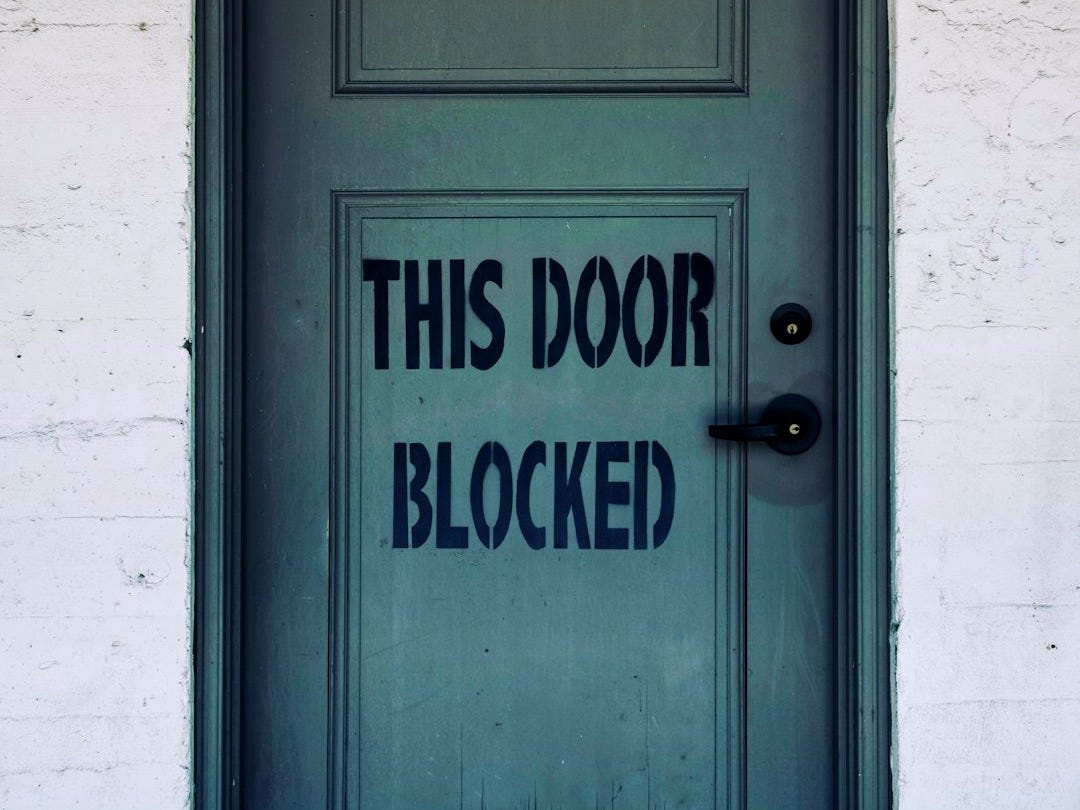
Now we have a button. One click. Block.
There’s something both harder and easier about it. Harder because it’s an active choice—you have to decide, deliberately, to cut someone off. You can’t blame circumstance or distance. Easier because you don't have to explain face-to-face. You can skip the confrontation entirely. You just... press the button.
The permanence of it. The finality. It’s the most explicit boundary-setting tool humans have ever had.
And I don’t use it lightly.
I actually don’t enjoy blocking people. It’s one of the last things I try to do. In the few instances where I’ve done it, I know I’m doing it because I tried everything else first. Because this person has lost access to me, and it needed to happen.
But here’s what I’ve learned: having access to a person is a privilege.
When you value what you can offer—your kindness, your energy, your genuine care for others’ wellbeing—you also have the responsibility to protect it.
As a father, I need to protect my mental health because it directly affects how I show up for my son. When I let conversations drain my energy—when I allow someone to disrespect me repeatedly, when I stay in exchanges that leave me frustrated and depleted—my son pays the price later.
He gets the tired version of me. The irritable version. The version who has less patience for his bedtime negotiations or his Minecraft explanations. The version who can’t fully be present because part of me is still processing whatever argument or criticism I just absorbed.
I owe it to him to protect my peace. And sometimes that means closing doors.
Silent Goodbyes
So after thinking about W’s message—“It would have been so easy to not say anything”—I realized he was right.
It would have been easier. And maybe that’s exactly what I should have been doing all along. Not just in that moment, but for years.
I thought about all the conversations where I’d tried to navigate his moods, where I’d carefully chosen words to avoid triggering an argument, where I’d withheld parts of myself to avoid mockery or criticism.
I thought about the access I’d already withdrawn without fully realizing it. How I’d stopped sharing what I loved. How every interaction had become exhausting.
I thought about how, after 30 years of friendship, I’d reached a point where I literally couldn’t find words that wouldn’t be wrong. Where saying something supportive would be criticized, but saying nothing would also be wrong.
And I blocked him.
I didn’t do it with anger. I did it with sadness, actually. Sadness for who we’d been, for the friend who loaned me his SNES and changed my taste in music. Sadness for all the years we’d been there for each other.
But I also did it with clarity.
Because sometimes the kindest thing you can do for yourself is close a door that should have been closed years ago. Sometimes protecting your peace isn’t selfish—it’s necessary. Sometimes managing who gets access to you is an act of self-preservation.
And sometimes saying nothing isn’t weakness or avoidance.
Sometimes it’s wisdom.
Closing the door to your kindness may also protect them from you opening the door to your anger. That’s a door I seldom open.
I’ve thought a lot about access since then. About how we open doors to strangers sometimes, giving them limited access to who we are—sharing our taste in music in a group setting, our hobbies, our surface-level interests. Testing to see if they’re safe, if they’ll respect what we share.
And how, if they pass that test, we might open another door. And another. Until eventually, with the people we trust most, we grant access to our most vulnerable selves.
Our hearts. Our tears. Our fears. Our weaknesses.
That’s what intimacy is: the gradual granting of deeper and deeper access, until someone knows you in ways almost nobody else does.
But it only works if the access is respected. If what we share is protected, not weaponized.
W had access to me for nearly 30 years. He knew my dreams, my passions, my struggles. And somewhere along the way, he stopped protecting what I shared and started using it as ammunition. Or simply dismissing it entirely.
So I took that access back.
Not because I stopped caring about him. Not because I don’t hope he finds peace and healing. But because I couldn’t keep giving pieces of myself to someone who would only break them.
Having access to a person is a privilege. Being granted access is a gift.
And sometimes, the most loving thing you can do—for yourself, for the people who depend on you, for your own mental health and peace—is to be very, very careful about who you give that gift to.
Even if that means pressing the block button on someone you’ve known for almost 30 years.
Even if it makes you sad.
Even if it’s hard.
Even if you hurt yourself in the process of saying goodbye.
Goodbye, my friend.
— Cae Rivas —
If you liked this, maybe you’ll like my previous reflection on the challenges of helping and being helped in modern times:

And if you made it this far, all I have to say is thank you for reading, for your time, and for being you. 😊
☕ Support My Work
Thank you for reading. If you enjoyed this and want to continue supporting my work, why not buy me a coffee?
If coffee is not for you (I get it) then liking, commenting or restacking will also be greatly appreciated.
😊
You are absolutely right, having someone as a friend is a gift and a privilege, and when we find a good one, we should take care of that relationship like it’s precious, because it is.
I’m grateful every day to be able to call you friend.
(Please don’t kill me for being allergic to cats 😅)
An excellent post and deeply moving. Honestly, the one doing the blocking was your “friend”. You took on the burden of maintaining connection and it was never returned. Friendships last and grow because effort is made by all involved the friendship. If only one side is invested, only one side is listening, then it’s no longer a relationship. It’s two people with history. And nostalgia only gets you so far.
I write this after recently having a similar epiphany with someone I had considered a friend. I suddenly realized I always initiated “getting together” unless they needed a favour. If they needed something I was suddenly important to them. To them I was never a priority and always a convenient option. I stopped messaging them. The last message from them was asking if I could give them a ride “out of town to a family event.” I regretfully declined.
Thank you for writing this. It provides clarity.
You didn’t block. You simply reclaimed yourself.